Why the Woman Lake Chain’s Ordinary High-Water Level (OHWL) Must be Maintained After the RAR: A Citizen‑Research Summary for Lake Residents
A group of concerned lake residents are researching reasons why the Woman Lake Chain is approaching historic lows. We are concerned the DNR and Cass SWCD are dismissing the need to maintain the Chain’s OHWL, as evidenced by the DNR presentation on June 25 when the presenter said the OHWL “is only for jurisdictional” purposes. As citizen researchers, we have uncovered a wider scope of the OHWL under various Minnesota Statutes. Currently the rock arch rapids (RAR) crest is set at 20.4” below the OHWL. When the fish passage gaps are added in, the difference goes to 29.4”. If maintaining the OHWL is dismissed by DNR and Cass SWCD, then we believe reaching and maintaining historical lake levels are at risk and considerably lower lake levels may be the norm regardless of the seasonal impact. Here is what we have uncovered.
OHWL Is the Lake’s Normal Condition Under Minnesota Law
Minnesota law is unambiguous: the ordinary high-water level (OHWL) is not an occasional peak or a flood event — it is the lake’s legally defined normal, sustained condition. Understanding this matters because OHWL is the foundation for every regulatory, ecological, and hydrologic decision the state makes about public waters.
The Statute Defines OHWL as the Lake’s Sustained Condition
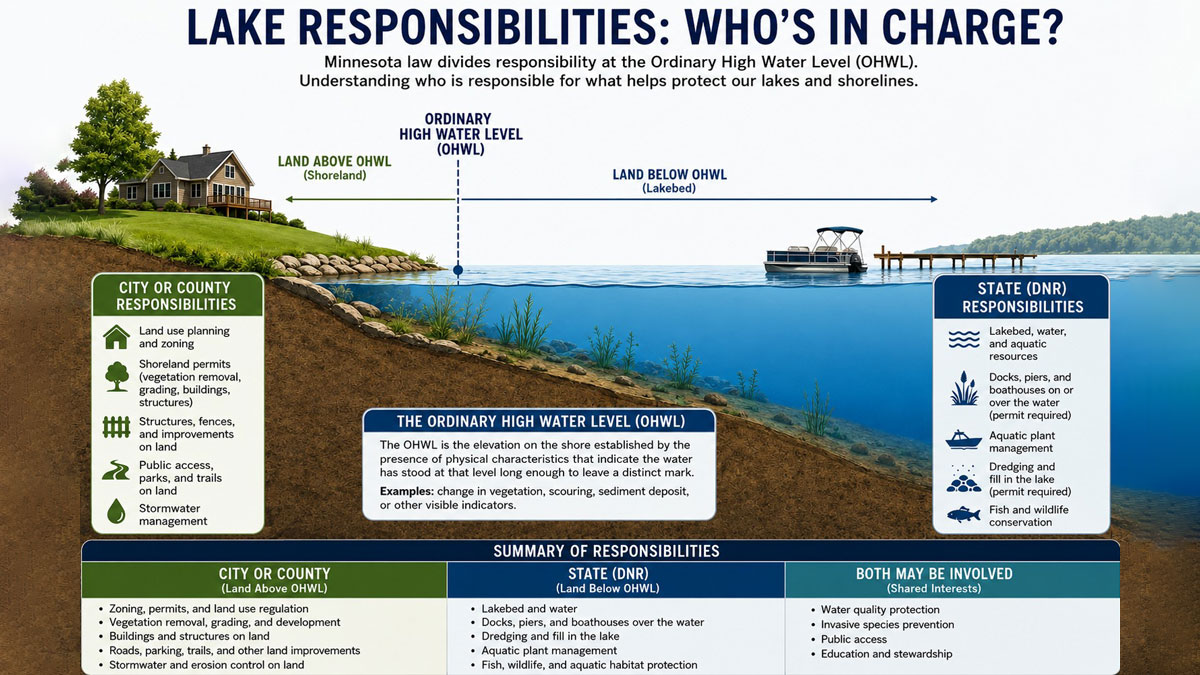
Minn. Stat. 103G.005, Subd. 14 describes OHWL as “the highest water level that has been maintained for a sufficient period of time to leave evidence upon the landscape.” This definition excludes temporary spikes, floods, or short‑term events. A water level must persist long enough to leave physical evidence — meaning it reflects the lake’s recurring, characteristic condition.
If an agency asserts that OHWL is not the lake’s normal condition, that claim contradicts the statute itself.
OHWL Is the Baseline for All Lake‑Related Regulation
Minnesota uses OHWL as the reference point for nearly every water‑management decision, including:
- shoreland zoning
- structure setbacks
- public waters permitting
- hydrologic modeling
- wetland delineation
- floodplain interaction
- outlet structure design
These systems depend on OHWL precisely because it represents the lake’s stable, normal water level. If OHWL were not the normal condition, it could not serve as the regulatory baseline.
Lowering a Lake Below OHWL Is a Regulated Alteration
Minn. Stat. 103G.245 requires a permit for any action that “changes or diminishes the course, current, or cross section of public waters.”
Holding a lake below OHWL does exactly that — it reduces the lake’s cross‑section, habitat, shoreline stability, and ecological function. This is legally considered an alteration of public waters.
If OHWL were not the lake’s normal condition, lowering a lake below it would not trigger regulation. But it does.
Dam Removal and Replacement Rules Require Maintaining Public Water Levels
Minnesota Rule 6115.0221 states that dam removal or replacement must not adversely affect public water resources or public water levels.
Setting an RAR crest below OHWL would depress the lake below its legally defined normal level, harming:
- public water levels
- aquatic habitat
- riparian rights
- shoreline vegetation
- recreational use
An RAR design that lowers a lake below OHWL cannot meet the rule’s requirements.
Outflow Management Must Still Protect OHWL
If an agency argues, “We manage outflow, not water levels,” the legal response is straightforward: Outflow management cannot be conducted in a way that depresses a lake below its OHWL. Because OHWL is the lake’s normal condition under statute, lowering the lake below that level constitutes a regulated alteration.
Management practices must align with maintaining the lake’s legally defined normal condition.
Conclusion: RAR Design Must Respect OHWL
Minnesota law establishes a clear framework:
- OHWL is defined as the lake’s sustained, characteristic water level.
- OHWL is the baseline for all lake‑related regulation.
- Lowering a lake below OHWL is a regulated alteration.
- Dam replacement rules prohibit adverse effects on public water levels.
Therefore, any RAR design must maintain the Woman Lake Chain of lakes at or near their OHWL. A design that depresses the lake below OHWL would conflict with multiple statutory and regulatory requirements.