Many people don’t realize that a relatively obscure organization within Cass County was responsible for the implementation of the new rock arch rapids (RAR) outlet on Girl Lake. Cass County Soil and Water Conservation District (Cass SWCD) served as the sponsor and fiscal agent for the project. The project also involved Minnesota DNR Fisheries (technical assistance), The Nature Conservancy, Houston Engineering, Inc. (engineering consultant), for and support from the Child-Girl-Woman Lakes Area Association.
About Cass SWCD
Cass SWCD is a completely separate political subdivision of the State of Minnesota, not a department or arm of Cass County government. It has its own independently elected board of supervisors. While SWCDs and county governments often partner closely—Cass County provides some funding or services under agreements, and the two boards may coordinate through a liaison committee—the SWCD remains a distinct local unit of government with its own statutory powers, budget process, and governance. It does not have independent taxing authority and typically presents a budget to the county for potential levy support, but decision-making authority on conservation policy, projects, and operations rests with the elected SWCD board.
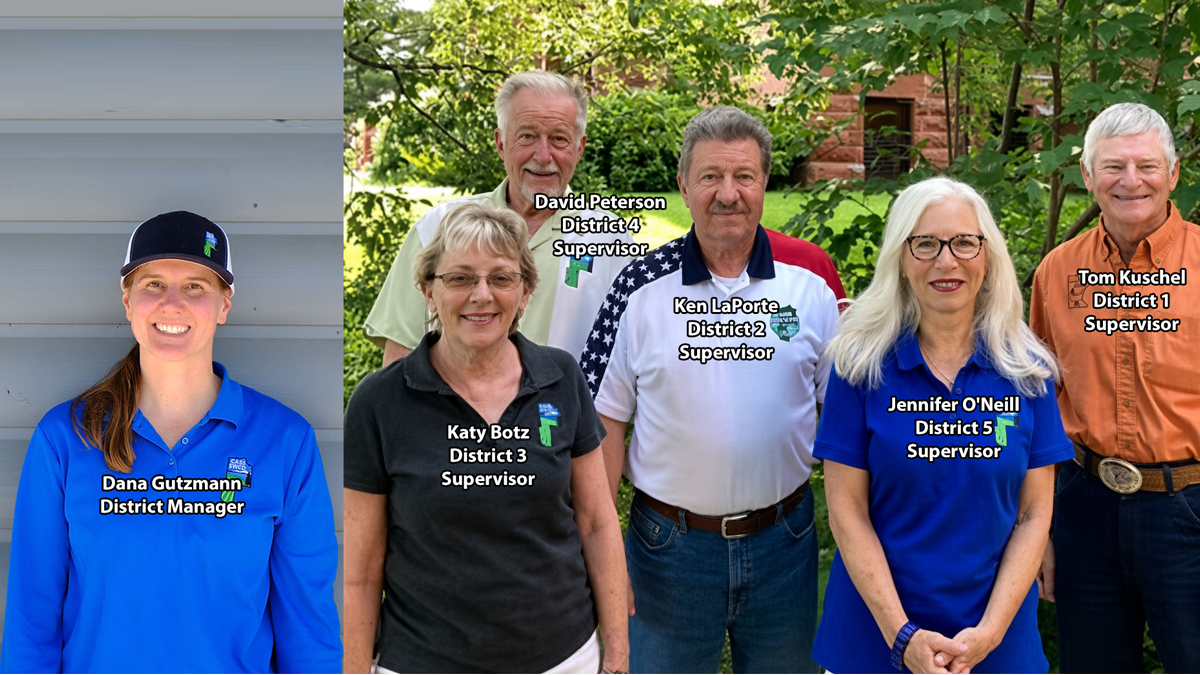
Cass SWCD is governed by a five-member board of supervisors, each elected from one of five numbered districts (also called nominating or supervisor districts). Each supervisor represents one district, and the full board handles policy, plans, budgets, and oversight of conservation programs across the county. The current supervisors are:
- District 1: Tom Kuschel (term ends 2026)
- District 2: Ken LaPorte (term ends 2028)
- District 3: Katy Botz (term ends 2028)
- District 4: David Peterson (term ends 2028)
- District 5: Jennifer O’Neill (term ends 2026)
Contact information for the board of supervisors is provided on the Cass SWCD website.
Cass SWCD typically holds its regular board meetings at 10:00 a.m. on the second Wednesday of every month. The next board meeting is an exception and is schedule for Thursday, November 12, 2026, at 10:00 a.m. in Backus at the Cass County Land Department Building, 218 Washburn Avenue, Backus, MN 56435.
Cass SWCD and the RAR Project
Dana Gutzmann, the District Manager for Cass SWCD, assumed overall responsibility for the RAR project.
Cass SWCD contracted Houston Engineering for professional engineering, design, and project management services. The project was framed as a nature-like replacement: a series of rock arch rapids intended to reconnect fragmented habitat (allowing upstream fish movement and creating resting/spawning areas), stabilize the outlet, and improve stream connectivity. Funding came from sources including a Conservation Partners Legacy grant, a Forest Service grant, and support from The Nature Conservancy. The completed structure is described as a seven-tier rock arch rapids that reconnected approximately 54 miles of the Boy River.
Cass SWCD managed the bidding process. In a September 9, 2025 special meeting, the SWCD board opened bids (lowest responsible bidder around the low-$200k range against a roughly $366k estimate) and moved to accept the lowest responsible bidder pending Houston Engineering review for completeness, compliance with specifications, and receipt of the DNR work permit.
Cass County project records repeatedly state two core objectives for the RAR: (1) maintain the historic runout elevation and (2) provide equivalent hydraulic performance to the old outlet. Crest elevation alone is not the full measure of hydraulic performance; factors such as crest width, gaps between rocks, foundation permeability, and overall structure behavior also affect how much water passes at different stages.
A May 2025 letter from DNR Fisheries to Cass SWCD Conservation Manager Dana Gutzmann clarified post-completion ownership: the structure would be owned and maintained by MNDNR Fisheries (entered into the State Dam Safety Inventory), and Cass SWCD would not have long-term maintenance responsibility. The effort was described as cooperative among the District, The Nature Conservancy, and MNDNR Fisheries.